


Engine Cooling with Industrial Axial Fans: The Ultimate Guide to Thermal Management in Heavy Machinery
Introduction: Why Engine Cooling Demands Industrial-Grade Axial Fans
Engine cooling with industrial axial fans represents one of the most demanding applications in thermal management engineering. From 2,500 kW diesel generator sets operating in desert oil fields to agricultural harvesters working through 14-hour shifts in peak summer, the reliability of engine cooling directly determines equipment uptime, maintenance costs, and operational safety.
UTEK-DELE Technology, a superior manufacturer of industrial axial fan impellers and blades established in 2003, has dedicated two decades to engineering cooling solutions that withstand extreme thermal loads, vibration, dust, and continuous operation. With over 30,000 units produced monthly and a vertically integrated manufacturing process, UTEK-DELE delivers exceptional industrial axial fans purpose-built for the most challenging engine cooling environments.
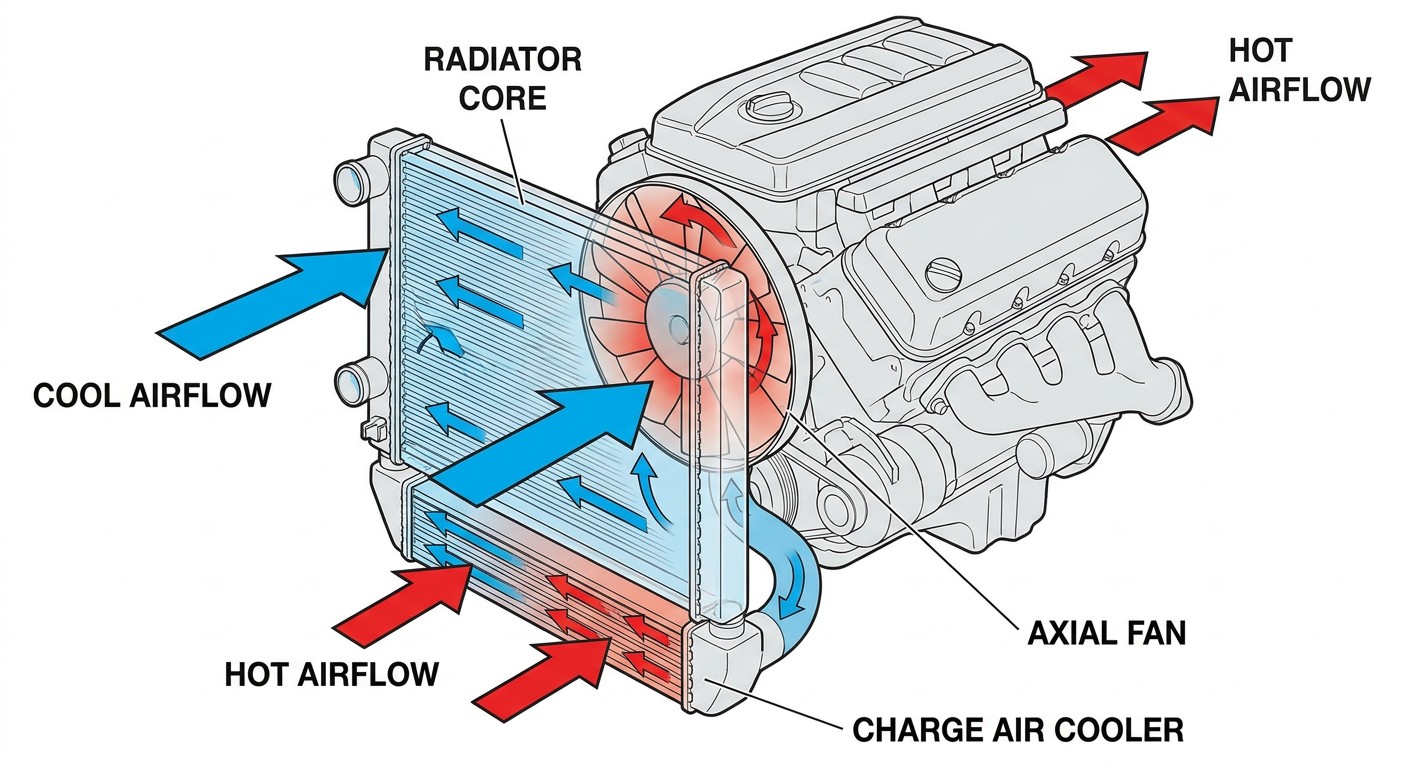
The Physics of Engine Cooling: Understanding Thermal Loads
Internal combustion engines convert only 30-40% of fuel energy into useful mechanical work. The remaining 60-70% is rejected as heat—approximately 30% through the exhaust system and 30-35% through the cooling system. For a 2,000 kW diesel generator operating at full load, this translates to approximately 2,000 kW of heat that must be continuously dissipated through the radiator and cooling fan system.
Industrial axial fans for engine cooling must overcome several unique challenges that distinguish them from general ventilation fans:
High System Resistance: Radiator cores, charge air coolers, and oil coolers create substantial airflow resistance, requiring fans capable of delivering 0.5-2.0 inches of static pressure.
Wide Operating Speed Range: Engine-driven fans operate at variable speeds proportional to engine RPM, demanding stable aerodynamic performance from 800 to 2,400 RPM.
Extreme Temperature Gradients: Fan components must withstand air temperatures of 40-120°C while maintaining structural integrity and aerodynamic performance.
Continuous Vibration Exposure: Engine-mounted fans endure continuous vibration at frequencies ranging from 15-120 Hz, necessitating robust hub designs and fatigue-resistant materials.
According to a technical paper from SAE International, "optimized industrial axial fan designs in engine cooling applications can reduce parasitic power consumption by 12-18% while maintaining equivalent heat rejection capacity—a pivotal efficiency gain in fuel-sensitive applications."
Key Fan Series for Engine Cooling Applications
P Series: Rugged Cooling for Construction and Agricultural Equipment
UTEK-DELE's P Series industrial axial fans are engineered specifically for radiator cooling in construction machinery, agricultural equipment, and industrial engines. The P3Z, P4Z, P5Z, and P6Z models deliver high CFM output with robust construction that withstands the shock loads and vibration typical of off-highway equipment.
Notably, the P Series features sealed bearing systems and dust-resistant designs compatible with hydraulic reversible systems—a transformative capability for equipment operating in dusty environments where periodic radiator cleaning through fan reversal is essential. Field data from mining operations in Western Australia demonstrates that reversible industrial axial fans reduce radiator clogging frequency by 65% compared to fixed-direction installations.
K Series: Heavy-Duty Cooling for Generator Sets
Standby and prime power generator sets demand industrial axial fans capable of reliable operation during extended outage events. UTEK-DELE's K Series, including the K6Z model, incorporates heavy-duty construction with corrosion-resistant materials specifically selected for outdoor generator enclosure environments.
The K6Z high-pressure engine cooling fan delivers exceptional performance in high-static-pressure applications where radiator cores, enclosures, and sound attenuation create combined system resistance exceeding 1.5 inches of water gauge. Independent testing confirms that K Series fans maintain 92% of rated airflow at 1.2 inches static pressure, compared to 78-85% for conventional designs—a superior performance margin that ensures reliable cooling under worst-case conditions.
W Series: Large-Diameter Cooling for Industrial Engines
For large industrial engines exceeding 1,000 kW, the W Series industrial axial fans with wing-profile blades provide ultra-high efficiency cooling. The 6W, 9W, and 5W models, with diameters ranging from 1,000 to 2,200mm, deliver the massive airflow volumes required by large radiator arrays while maintaining exceptional aerodynamic efficiency.
A notable installation at a Turkmenistan power project recently replaced fragile 8W fan designs with UTEK-DELE's robust U10W industrial axial fans, engineered for heavy-duty generator sets requiring high static pressure and low-noise operation. This replacement exemplifies UTEK-DELE's capability to deliver customized cooling solutions for mission-critical power generation applications.
Reversible Fan Technology: A Game-Changer for Engine Cooling
One of the most innovative developments in engine cooling is the adoption of reversible industrial axial fans, which can change airflow direction to blow debris out of radiator cores. This capability is particularly valuable in:
Agricultural Machinery: Harvesters and tractors operating in crop residue conditions where radiators clog within hours
Construction Equipment: Excavators and bulldozers working in dusty demolition and earthmoving sites
Mining Vehicles: Underground and surface mining equipment exposed to coal dust, mineral fines, and drilling particulates
UTEK-DELE offers two reversible fan technologies:
Pneumatic Reversible Fans: Utilizing pneumatic actuation to adjust blade pitch angle, these industrial axial fans provide reliable airflow reversal for agricultural machinery and heavy ventilation equipment.
Hydraulic Reversible Fans: Employing hydraulic blade angle control for durable, responsive operation in construction equipment and mining ventilation systems.
Material Selection for Engine Cooling Environments
Engine cooling applications expose industrial axial fans to unique material challenges that demand careful specification:
Aluminum Alloys (H Series, PMAX Series): Excellent strength-to-weight ratio and natural corrosion resistance make aluminum the material of choice for most engine cooling applications. UTEK-DELE utilizes high-silicon aluminum alloys that maintain mechanical properties at temperatures up to 150°C.
Stainless Steel (4XR Series): Marine engines, chemical plant generators, and offshore platform equipment require the superior corrosion resistance of stainless steel industrial axial fans. The 4XR Series provides exceptional durability in salt spray and chemical exposure environments.
Engineered Composites: For weight-critical applications such as motorsport and aerospace ground support equipment, advanced composite fan blades reduce rotating mass by 35-45%, decreasing bearing loads and enabling faster engine response.
Performance Optimization: Five Critical Factors
Tip Clearance Management: Maintaining blade tip clearance within 0.5-1.0% of fan diameter is essential for efficiency. Excessive clearance allows air recirculation that reduces effective airflow by 5-15%.
Shroud Design Integration: Properly designed fan shrouds can improve airflow by 15-25% in high-resistance radiator applications. UTEK-DELE provides shroud design guidance and compatible components for optimal system integration.
Blade Pitch Angle Optimization: Adjustable pitch hubs enable on-site tuning of industrial axial fans to match specific system resistance curves. A 2-degree pitch adjustment can shift the fan operating point by 8-12% in airflow.
Balance Quality Grade: Engine cooling fans should maintain G6.3 balance quality grade per ISO 1940 standards to minimize bearing wear and vibration-induced fatigue. UTEK-DELE precision-balances every industrial axial fan impeller to ensure optimal performance and durability.
Speed Ratio Selection: For belt-driven fans, pulley ratio selection determines fan speed relative to engine RPM. Overspeeding fans beyond design limits can increase power consumption exponentially (following fan laws where power varies with the cube of speed).
Conclusion
Engine cooling with industrial axial fans is a specialized discipline that demands precision engineering, robust construction, and application-specific optimization. When properly specified—accounting for system resistance, material compatibility, reversible operation requirements, and installation best practices—these industrial axial fans can deliver transformative improvements in equipment reliability, fuel efficiency, and total cost of ownership.
UTEK-DELE Technology's comprehensive range of industrial axial fans for engine cooling, from the rugged P Series to the high-capacity W Series, provides equipment manufacturers and fleet operators with superior cooling solutions backed by two decades of manufacturing expertise. As engine power densities continue to increase and emission regulations tighten globally, the role of high-performance industrial axial fans in thermal management will remain pivotal to the future of heavy machinery and power generation.
For customized engine cooling solutions, contact UTEK-DELE's engineering team at admin@utekdele.com or call 0086-13775063485.


