


What is an Industrial Axial Flow Fan Used For?
In the complex landscape of heavy machinery and thermal management, the industrial axial flow fan stands as a pivotal component, driving efficiency across a multitude of sectors. Unlike standard residential cooling devices, these robust systems are engineered to move vast volumes of air at low to medium static pressures, making them indispensable for operations requiring consistent heat dissipation and ventilation. Whether integrated into massive cooling towers or precision-engineered for mobile construction machinery, the industrial axial flow fan is the heartbeat of modern airflow systems.
For engineers and procurement specialists, understanding the specific utility of these fans is crucial. Manufacturers such as UTEK-DELE Technology Changzhou Co., Ltd have spent over two decades refining these technologies, producing specialized series ranging from compact 300mm units to massive 2200mm impellers. This article delves into the engineering principles, diverse applications, and performance metrics that define what an industrial axial flow fan is used for in today’s demanding industrial environments.
The Engineering Mechanics: How It Works
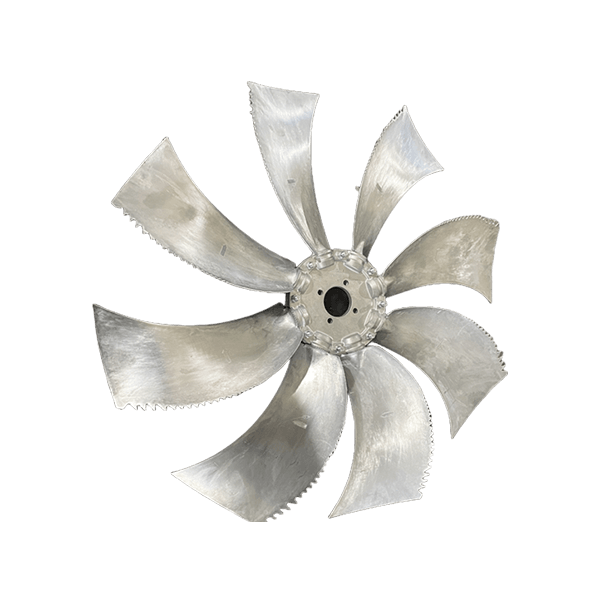
To understand the application, one must first grasp the mechanism. An industrial axial flow fan operates on the principle of aerodynamic lift. The blades, often shaped like airfoils or sickles, rotate around a central axis, drawing air in parallel to the shaft and forcing it out in the same direction. This linear airflow distinguishes it from centrifugal fans, which move air radially.
The design architecture allows for high flow rates (CFM) with high efficiency. For instance, airfoil blades (often seen in large-diameter W Series fans) are designed to minimize turbulence and noise while maximizing air movement. Conversely, sickle blades (common in S Series models) are optimized for lower noise emissions and higher pressure stability. This versatility allows the industrial axial flow fan to be tailored to specific aerodynamic requirements, balancing static pressure against airflow volume.
Critical Applications in HVAC and Refrigeration
One of the primary uses of an industrial axial flow fan is within Heating, Ventilation, and Air Conditioning (HVAC) systems. Here, they serve as the primary movers for heat exchange processes.
Condensers and Evaporators: In large-scale commercial refrigeration, fans must operate continuously to dissipate heat. Stainless steel or anti-corrosion coated fans (such as the 4XR Series) are frequently employed in these environments to withstand humidity and chemical exposure.
Air Handling Units (AHUs): High-efficiency fans ensure that conditioned air is distributed evenly throughout large facilities. The focus here is on energy efficiency; advanced designs can reduce energy consumption by up to 30% compared to legacy models.
Cooling Towers: For industrial cooling towers, large diameter fans (1000mm–2200mm) are essential. These units, often utilizing airfoil blades, provide the massive airflow needed to cool process water in power plants and manufacturing facilities.
Engine Cooling and Mobile Machinery
Beyond stationary HVAC systems, the industrial axial flow fan is transformative in the realm of mobile heavy machinery. Internal combustion engines in excavators, bulldozers, and harvesters generate immense heat that must be managed to prevent catastrophic failure.
In these applications, fans like the K Series or P Series are mounted directly to radiators. They are engineered to deliver high static pressure to overcome the resistance of dense radiator cores. Furthermore, the durability of these fans is paramount; they must withstand high vibration, dust, and extreme temperature fluctuations. Specialized designs, such as the P3Z or P6Z high-CFM assembly fans, are often customized to meet OEM specifications for gensets and power equipment, ensuring the engine operates within its optimal thermal envelope.
Agricultural and Livestock Ventilation
The agricultural sector relies heavily on the industrial axial flow fan for yield protection and livestock welfare. The requirements here differ significantly from engine cooling, prioritizing volume and coverage over extreme pressure.
Grain Drying Systems
In grain dryers and kilns, uniform airflow is critical to prevent spoilage. Fans used in these settings must endure high temperatures and potential abrasion from dust particles. Manufacturers provide durable solutions that ensure consistent drying rates, directly impacting the quality of the harvest.
Livestock Ventilation
For poultry houses and dairy barns, ventilation is a matter of animal health. Fans like the 7XL Series are designed to move large amounts of air to control ammonia levels, humidity, and temperature. Low-noise operation (often ≤65 dB) is a specific requirement in these applications to avoid stressing the livestock, demonstrating how the industrial axial flow fan adapts to biological constraints.
Advanced Solutions: Reversible and Explosion-Proof Fans
Innovation in blade technology has expanded the utility of these fans into specialized territories. A notable advancement is the development of reversible fans.
Reversible Axial Fans: In environments with high debris, such as forestry or mining, radiators can quickly become clogged. Pneumatic and hydraulic reversible fans allow the operator to reverse the pitch of the blades or the direction of rotation. This reverses the airflow, effectively purging dust and debris from the radiator grille without shutting down the machine. This capability significantly reduces maintenance downtime.
Hazardous Environments: In mining and chemical processing, safety is non-negotiable. Explosion-proof fans (such as the 7Z Series) are engineered with non-sparking materials and specialized motors. These are used for smoke extraction in tunnels and ventilation in volatile atmospheres, where standard equipment would pose a severe ignition risk.
Material Selection and Customization
The longevity of an industrial axial flow fan is dictated by its material composition. Leading manufacturers like UTEK-DELE utilize a range of materials to suit the operating environment:
Reinforced Nylon/Plastic: Ideal for standard temperatures and lightweight requirements.
Aluminum Alloy: Offers a balance of strength and weight, suitable for high-speed engine cooling.
Stainless Steel: Essential for corrosive environments, such as marine condensers or chemical plants (exemplified by the 4XR Series).
Furthermore, precision balancing to ISO 1940 standards ensures that these fans operate without inducing damaging vibrations into the machinery they cool. Customization extends to the blade pitch angle, which can be adjusted to fine-tune the airflow performance without changing the motor speed.
Conclusion
The question "what is an industrial axial flow fan used for?" yields a multifaceted answer that touches almost every aspect of modern infrastructure. From the silent operation of HVAC systems in commercial buildings to the rugged, dust-purging blasts of reversible fans in mining excavators, these components are the unsung heroes of thermal dynamics. An industrial axial flow fan can significantly enhance operational efficiency, extend equipment lifespan, and ensure safety compliance when the blade design, material, and size are correctly optimized.
As industries strive for higher efficiency and lower energy footprints, the role of precision-engineered airflow solutions becomes increasingly critical. Partnering with experienced manufacturers like UTEK-DELE Technology Changzhou Co., Ltd ensures access to high-performance, custom-tailored solutions that meet the rigorous demands of global industry.


