


Guide to Replacing Industrial Fan Blades: Key Specs for Axial Fans
In the demanding world of industrial ventilation and cooling systems, worn or damaged industrial fan blades can lead to reduced airflow efficiency, increased energy consumption, and even system failures. For axial fans used in HVAC, engine cooling, and heavy machinery, timely replacement is critical to maintain optimal performance. This guide draws on over 20 years of engineering expertise in industrial axial fans, outlining the essential specifications and processes to ensure seamless replacements. By focusing on precise measurements and material compatibility, you can avoid costly downtime and extend equipment life.
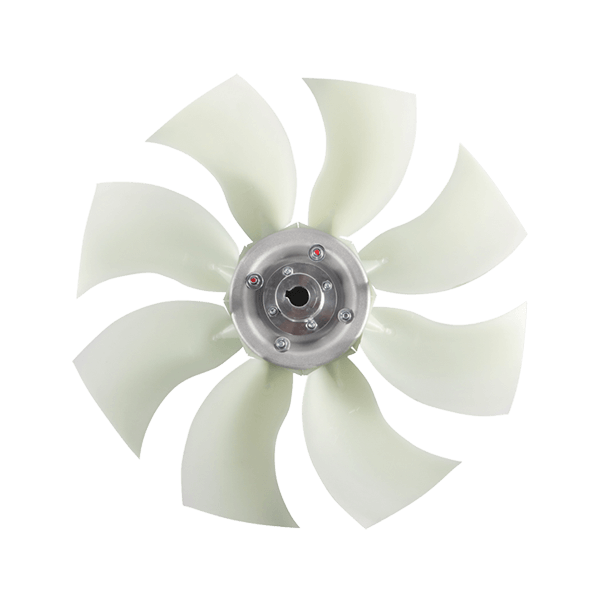
Understanding Key Specifications for Industrial Fan Blades
Axial fan blades operate by accelerating air parallel to the fan's rotational axis, generating high-volume airflow (CFM) through aerodynamic principles. Replacing them requires matching critical specs to preserve balance, efficiency, and safety. Mismatches can cause vibration exceeding ISO 1940-1 G2.5 standards or reduce static pressure by up to 30%.
Diameter and Pitch Angle
Diameter: Measured tip-to-tip across the blade circle, typically ranging from 300mm for small axial fan blades to 2200mm for large industrial models. A 1% deviation can drop airflow by 5-10%.
Pitch Angle: The blade's angle relative to the plane of rotation, often adjustable from 10° to 45° in reversible designs. Hydraulic or pneumatic reversible industrial fan blades (e.g., PMAX or R4Z series) allow pitch shifts for bidirectional flow, critical for agriculture or mining applications.
Material Composition and Durability
Modern industrial fan blades use aerospace-grade aluminum alloys (e.g., AlSi7Mg0.3 with 250-300 MPa tensile strength) or stainless steel (AISI 316 for corrosion resistance in marine environments). Airfoil designs (e.g., W Series) offer 20% higher efficiency than sickle blades (e.g., U Series), per AMCA 210 testing. Look for anti-corrosion coatings and IP55-rated hubs to withstand temperatures from -40°C to 120°C.
Blade Count, Hub, and Balance
Blade Count: 3-9 blades; more blades increase static pressure but raise noise (target ≤65 dB(A)).
Hub Compatibility: Taper bush or keyed hubs ensure torque transmission up to 500 Nm.
Dynamic Balancing: Post-replacement, blades must meet ISO 1940 G1.0 standards, verified via precision equipment like those used in wind tunnel tests.
Industry reports from AMCA highlight that properly spec'd replacements improve energy efficiency by 15-25%.
Step-by-Step Guide to Replacing Axial Fan Blades
Replacing industrial fan blades demands precision to avoid imbalance. Follow these steps for safe, effective installation:
Shutdown and Safety Check: Power down the system, lock out/tag out (LOTO per OSHA 1910.147), and inspect for wear like erosion or cracks using non-destructive testing (NDT) methods.
Measure Existing Blades: Use digital calipers for diameter (±0.5mm accuracy), pitch gauge for angle, and borescope for hub wear. Document RPM (typically 800-1800) and CFM ratings.
Select Compatible Replacements: Cross-reference specs against OEM data sheets. For custom needs, provide 2D/3D drawings ensuring material matches (e.g., corrosion-resistant for evaporative coolers).
Disassembly: Remove the motor and hub assembly. Torque bolts to 20-50 Nm during removal to prevent thread damage.
Installation and Balancing: Mount new axial fan blades, torque to manufacturer specs (e.g., M12 bolts at 60 Nm), and perform static/dynamic balancing on-site or via specialized machines. Run at operational speed, monitoring vibration (<4.5 mm/s RMS per ISO 10816).
Testing and Commissioning: Verify airflow with anemometers (AMCA-certified), check noise, and adjust pitch if reversible. Log data for warranty compliance (typically 12 months).
Tools like laser alignment systems reduce installation time by 40%.
Real-World Applications and Case Studies
In HVAC systems, replacing sickle-blade industrial fan blades in heat exchangers restored 25% airflow in a commercial facility, cutting energy costs amid high-humidity challenges. For engine cooling in construction machinery (e.g., excavators), hydraulic reversible axial fan blades like the K6Z series handled dust-laden environments, preventing overheating under 50 kW loads.
A mining operation upgraded explosion-proof 7Z Series blades (ATEX-compliant), overcoming smoke extraction issues with high-static-pressure designs. In cooling towers, 9W airfoil industrial fan blades (1000-2200mm) boosted efficiency by 20%, as validated by recent field studies. These examples underscore how spec-matched replacements address corrosion, vibration, and thermal stress in sectors like agriculture and power generation.
Key Takeaways for Optimal Industrial Fan Blade Replacement
Successful replacement hinges on precise specs—diameter, pitch, materials, and balancing—to sustain performance in industrial axial fans. Prioritize ISO/AMCA standards and compatibility to minimize risks.
As industries evolve toward energy-efficient, reversible systems, selecting durable industrial fan blades ensures longevity and adaptability. Consult technical data sheets or experts for tailored guidance, safeguarding your operations for years ahead.
At UTEK-DELE Technology Changzhou Co., Ltd., we engineer precision solutions for these challenges. Learn more at https://www.utekdelefan.com/.


