


What is an Axial Impeller Fan?
In the demanding world of industrial ventilation and cooling, the axial impeller fan stands as a pivotal component, engineered to generate high-volume axial airflow with exceptional efficiency. But what is an axial impeller fan exactly? At its core, an axial impeller fan—often referred to as an industrial axial impeller fan—is the rotating assembly within axial flow fans that converts rotational torque into directed airflow parallel to the shaft axis. This design excels in applications requiring massive air movement, such as HVAC systems, engine radiators, cooling towers, and heavy machinery ventilation.
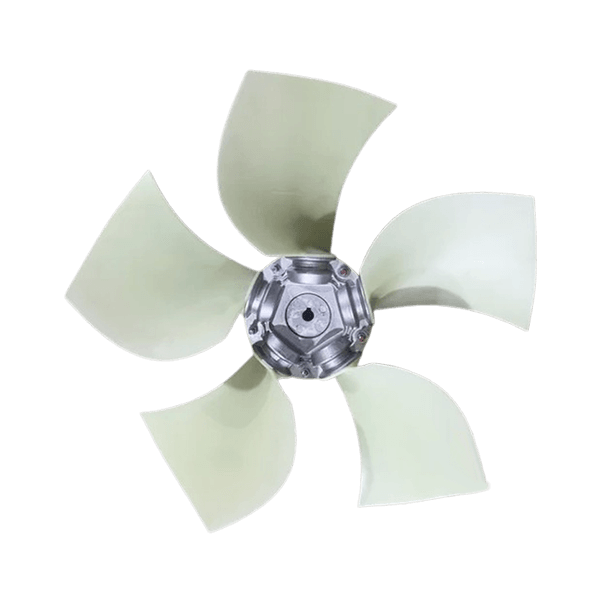
With industries facing escalating demands for energy efficiency and reliability, understanding the mechanics of an axial impeller fan is essential. These fans address key challenges like high static pressure, noise reduction, and corrosion resistance, offering transformative solutions that can boost system performance by up to 30%. Manufacturers like UTEK-DELE Technology Changzhou Co., Ltd specialize in custom industrial axial impeller fans, delivering airfoil and sickle blade designs tailored for diverse sectors including agriculture, mining, and power generation. This guide delves into the engineering principles, design factors, and applications that make axial impeller fans indispensable.
Fundamentals of Axial Impeller Fan Design and Operation
An axial impeller fan comprises a hub-mounted set of blades—typically airfoil or sickle-shaped—that propel air axially through the fan housing. Unlike centrifugal fans, which redirect airflow radially, the axial impeller fan maintains flow direction for superior volume handling, often achieving CFM ratings exceeding 100,000 in large industrial models.
Key engineering principles include aerodynamic optimization via pitch angle adjustments and blade twist, ensuring laminar flow and minimal turbulence. For instance, variable-pitch industrial axial impeller fans allow reversible airflow, critical for agriculture machinery and smoke extraction. Materials such as aluminum alloys, stainless steel, or composite reinforcements provide corrosion resistance in harsh environments, with precision balancing per ISO 1940 standards to eliminate vibration.
"The axial impeller fan's airfoil blade profile mimics aircraft wings, generating lift forces that translate into powerful thrust for industrial airflow," notes UTEK-DELE's engineering lead, emphasizing decades of wind tunnel-tested innovations.
Challenges and Critical Factors Influencing Axial Impeller Fan Performance
Despite their versatility, axial impeller fans encounter challenges like airflow inefficiency at off-design speeds, excessive noise in high-RPM operations, and material degradation in corrosive settings. Factors such as blade diameter (300-2200mm), hub-to-tip ratio, and motor integration directly impact static pressure and efficiency.
Additionally, environmental variables—temperature extremes, dust ingress, and humidity—necessitate robust designs. In contrast to standard fans, industrial axial impeller fans must comply with ATEX for explosion-proof applications or IP55 for dust/moisture resistance, ensuring 24/7 reliability in mining tunnels or livestock ventilation.
Diameter and Pitch: Larger impellers (e.g., 1000-2200mm) yield higher CFM but demand stronger hubs.
Material Selection: Stainless steel for marine use; composites for weight reduction in wind turbines.
Noise and Vibration: Curved sickle blades reduce decibels to ≤65 dB.
Best Practices for Selecting and Optimizing Industrial Axial Impeller Fans
Selecting the right axial impeller fan requires a systematic approach. Follow these numbered steps for optimal integration:
Assess Application Needs: Calculate required CFM, static pressure, and airflow direction (unidirectional or reversible).
Review Design Specs: Prioritize airfoil blades for efficiency or sickle for high-pressure scenarios, matching diameters like UTEK-DELE's W Series (1000-2200mm).
Test Compatibility: Ensure motor RPM alignment and pitch control (pneumatic/hydraulic) for variable loads.
Conduct Performance Validation: Use wind tunnel data or CFD simulations for 20-30% efficiency gains.
Implement Maintenance Protocols: Schedule quarterly balancing and blade inspections for longevity.
Maintenance Tips for Longevity
Regular cleaning prevents buildup, while dynamic balancing mitigates wear. UTEK-DELE's in-house equipment, like hand laser welders and balance machines, exemplifies precision manufacturing.
Performance Data and Efficiency Metrics of Axial Impeller Fans
Data-driven insights underscore the superiority of advanced axial impeller fans. For example, UTEK-DELE's PMAX Series industrial axial impeller fans deliver 25% higher CFM than legacy models at equivalent power draw, with static efficiencies reaching 85% in radiator cooling tests. Comparative studies show reversible designs reducing energy consumption by 30% in hydraulic systems.
| Series | Diameter (mm) | Max CFM | Efficiency (%) | Noise (dB) |
|---|---|---|---|---|
| P Series | 500-1100 | 50,000 | 82 | 70 |
| W Series | 1000-2200 | 150,000 | 88 | 65 |
| U Series | 1000-2200 | 120,000 | 85 | 62 |
These metrics highlight how optimized axial impeller fans transform operational costs.
Real-World Applications and Case Studies
Axial impeller fans power diverse industries. In HVAC, low-noise S Series fans enhance air handling units. Engine cooling benefits from K6Z high-pressure impellers in gensets, while cooling towers leverage W Series airfoil blades for 20% airflow gains.
Case in point: A mining operation integrated UTEK-DELE's 7Z explosion-proof industrial axial impeller fans, achieving 40% better smoke extraction and compliance. Similarly, agricultural grain dryers using reversible pneumatic models reported uniform drying with 15% energy savings.
Conclusion: Unlocking Superior Performance with Axial Impeller Fans
In summary, an axial impeller fan is the cornerstone of high-efficiency industrial airflow, delivering unparalleled CFM, pressure, and adaptability when key factors like blade aerodynamics, material durability, and custom pitch controls are optimized. Industrial axial impeller fans from leaders like UTEK-DELE Technology Changzhou Co., Ltd exemplify this potential, with monthly capacities exceeding 30,000 units and proven ROI in HVAC, engine cooling, and beyond.
Looking ahead, advancements in composite materials and AI-driven designs promise even greater efficiencies. For tailored solutions, contact UTEK-DELE to elevate your cooling systems—where precision engineering meets industrial demands.


