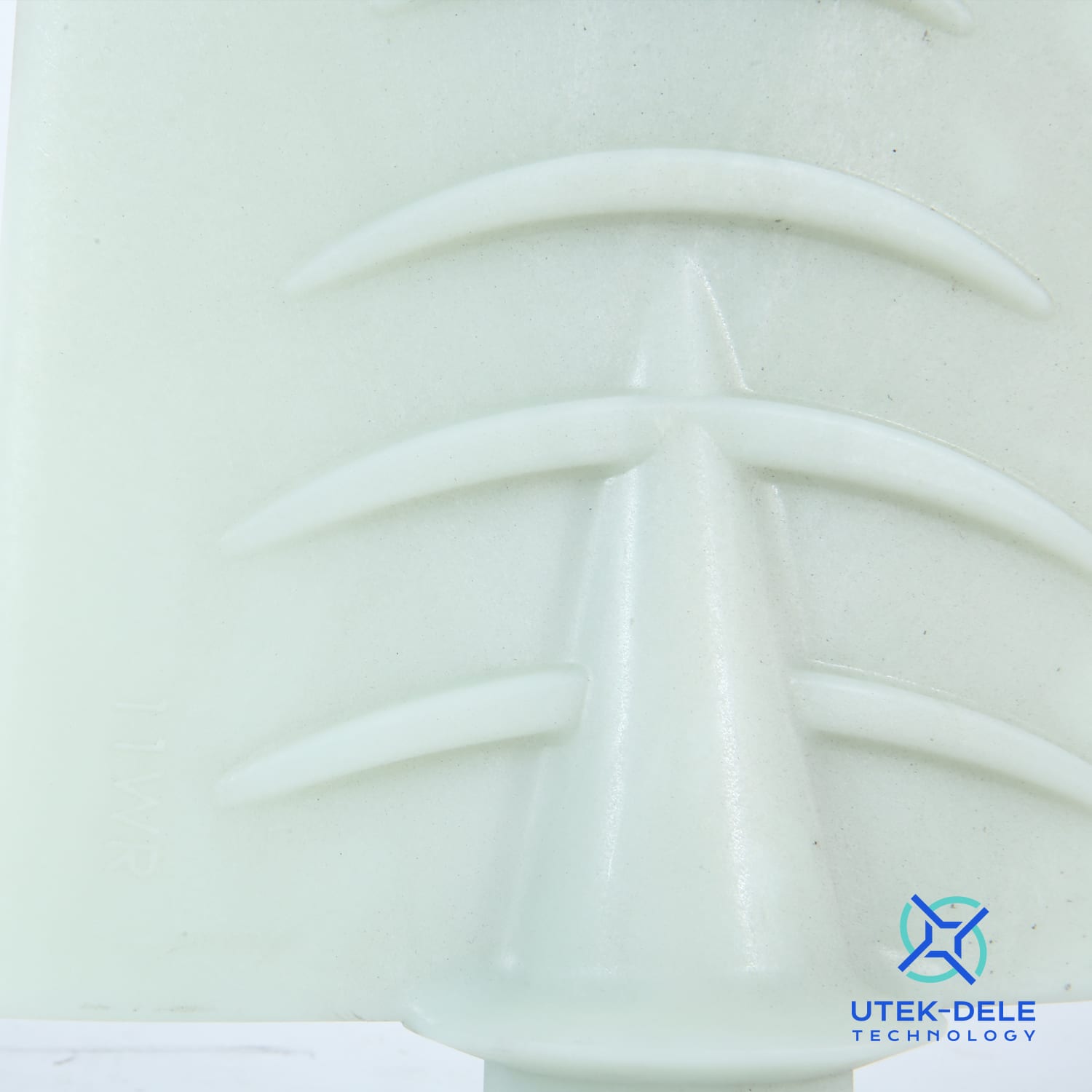


The 11W is an adjustable-pitch axial fan blade for high performance moving-air units, covering 560-2200 mm with 6 to 12 blades on the W-3 hub in moulded PAG or conductive PAGAS.
Adjustable pitch set at assembly and re-trimmable in service
560-2200 mm diameter range with 6-12 blades
PAG and conductive PAGAS blade options on the W-3 hub
The 11W is an adjustable-pitch axial fan blade for high performance moving-air units, covering 560-2200 mm with 6-12 blades on the W-3 hub. It is the large-diameter end of the UTEK-DELE blade range: a slow, wide impeller that moves a high air volume with low power consumption and low blade-passing noise.
Blades are moulded in PAG for general heavy-load cooling, in conductive PAGAS where static discharge has to be avoided, and cast in aluminium ADC12 for high-temperature duties. Each blade set is assembled on its hub and balanced before shipment, so a replacement behaves like the fan it replaces.
Adjustable pitch — the blade angle is set at assembly to the duty point and recorded for repeat orders
Diameter range 560-2200 mm with 6-12 blades on the W-3 hub
Three blade materials: PAG, conductive PAGAS and die-cast aluminium ADC12
Balanced as an impeller on a hand laser balancing machine before shipment
Suitable for both new fans and replacement of an existing large fan
| Item | Specification |
|---|---|
| Model | 11W |
| Blade type | Adjustable pitch (angle set at assembly) |
| Diameter range | 560-2200 mm |
| Blade count | 6-12 |
| Hub | W-3 family |
| Blade materials | PAG / conductive PAGAS / ALU (ADC12) |
| Balancing | Dynamic balancing on a hand laser balancing machine |
| Applications | Moving-air units, cooling towers, industrial ventilation, livestock housing |
| Material | Composition | Temperature range | Typical duty |
|---|---|---|---|
| PAG | PA6 with 30% glass fibre | -40 °C to 110 °C | Standard heavy-load blade |
| PAGAS | PA6 with 15% carbon fibre and 15% glass fibre (conductive) | -30 °C to 100 °C | Dust and gas atmospheres where static discharge must be avoided |
| ALU | Die-cast aluminium ADC12 | -40 °C to 150 °C, short-term 300 °C for 2 h | High-temperature zones |
11W Adjustable-Pitch Axial Fan Blade — Field Installation — watch on YouTube
The 11W belongs to the range. The related pages are W Series large industrial axial fans, industrial axial fan propellers, industrial axial fan blades, industrial axial fan impellers, U Series large axial fans.
Support starts before the blade is quoted. The points below are the ones that decide whether an 11W fits an existing fan or a new cooling pack, and they are the same checks used for OEM programs and retrofit work.
Diameter — set by the fan ring or shroud that is available, since this fixes the achievable air volume at the working speed
Airflow and static pressure — the duty point the fan has to meet at the working speed
Blade count — raised for pressure and lower airflow, lowered for maximum air volume and lower blade-passing noise
Material — decided by the maximum air temperature and by whether static discharge has to be avoided
Hub and shaft interface — confirmed before the blade set is released for production
Selection follows that order because changing a later step normally means going back to the first: blade count and hub rating both limit what a given diameter can carry at the working speed.
A replacement does not have to match a drawing, only the interface that already exists on the machine:
Connection holes and bushings are machined to match the existing hub, so the blade set can be fitted
The blade count and blade type of the original fan are confirmed, which preserves the original airflow and noise level
The hub family is verified against the shaft, including the taper bush where one is used
The assembled impeller is balanced before shipment, so no balancing rig is needed on site
Every impeller is balanced on a hand laser balancing machine before shipment. On a large-diameter blade this matters more than on a small one, because imbalance grows with diameter and blade mass and shows up as vibration, fastener loosening and bearing wear. Balance settings and blade count are recorded so a later replacement can be matched to the same condition.
Blade count, blade profile, pitch setting, hub family and material can all be fixed for an OEM program, and an existing fan can be reviewed when the cooling pack or the ventilation duty is revised:
Blade count and pitch angle set to the required airflow and pressure
Hub and shaft interface matched to the existing drive
Material selected against temperature and atmosphere (PAG, conductive PAGAS, ALU)
Replacement programs where only the blades are renewed and the hub stays in service
Material and test records are available for projects that require them: certificate of analysis for the material and for the finished PAGAS blade, UV resistance and fire behaviour reports for PAG, and explosion-proof type test reports where conductive blades are used in a classified atmosphere. Certificate and report copies are provided on request rather than published as current certifications.
The 11W is specified where a large air volume has to be moved continuously with moderate pressure: applications where a large slow impeller is more efficient and quieter than a smaller fast fan. The duties below are the ones this blade is normally ordered for.
High performance moving-air units, where a large slow impeller moves more air per kW
Cooling towers and industrial heat exchangers
Industrial ventilation with regulated noise levels
Livestock housing and agricultural ventilation
Replacement of failed large fans where the existing hub and shaft are still serviceable
| Application | Duty characteristic | Diameter | Blades | Hub | Material |
|---|---|---|---|---|---|
| Moving-air unit | High air volume at low speed | 1000-2200 mm | 6-8 | W-3 | PAG / PAGAS |
| Cooling tower | Continuous duty, weather exposed | 1000-2200 mm | 8-10 | W-3 | PAG / ALU |
| Industrial ventilation | Noise regulated | 560-1343 mm | 8-12 | W-3 | PAG / PAGAS |
| High-temperature exhaust | Air above 110 °C | 560-1343 mm | 6-10 | W-3 | ALU (ADC12) |
| Replacement / retrofit | Match existing hub and shaft | As measured | As original | W-3 | As original |
The matrix is a starting point rather than a final specification: diameter is confirmed against the installation, then blade count and material are fixed against the duty point and the air temperature.
Most orders for this blade are replacements rather than new fans, and they follow the same pattern:
A large fan in a cooling tower or moving-air unit fails, and the hub and shaft are still serviceable
The original diameter and blade count are confirmed from the fan records or measured on site
Connection holes and bushings are machined to the existing hub so the blade set fits without modification
The replacement impeller is balanced before shipment and the fan returns to service without on-site balancing
Where the whole hub has to be renewed, the hub is matched to the existing shaft instead
Because the blade family is unchanged in production, a fan commissioned years ago can be re-bladed to the same airflow and noise condition, which keeps a fleet of machines on one specification.
Installation and commissioning support covers the practical points: blade angle set at assembly, hub clamping and fastener checks, and confirmation that the fan reaches its duty point after the machine is back in service. Field installation for this blade is shown in the product video on the Product Features tab.
UTEK-DELE (Changzhou Dele Ventilation and Heat Dissipation Technology Co., Ltd.) designs and manufactures axial fan blades, impellers and complete fan assemblies. The range covers moulded PAG and conductive PAGAS blades, die-cast aluminium blades, hubs from H-6 to H-12 and the Z and W families, and finished impellers from 180 mm up to 2200 mm for engine cooling, cooling towers and industrial ventilation.
Production, balancing and inspection are carried out in house, which is what makes a replacement blade or impeller behave like the part it replaces: the same blade geometry, the same hub interface and the same balancing record are reproducible years after the original fan was built.
Blade moulding, hub machining, assembly and packing are handled under one roof, so a fan specification can be reviewed end to end before it is released for production.
 |  |  |
 |  |  |
The equipment that decides fan quality is the balancing and test equipment, because imbalance and airflow errors are what a customer feels in service.
 Dynamic Balancing Equipment |  Dynamic Balancing Equipment |  Dynamic Balancing Equipment |
 Cutting Machine Equipment |  Cutting Machine Equipment |  Wind Tunnel Laboratory |
The blade and reversible fan designs are protected by granted Chinese patents, and the company operates under ISO9001 and ISO14001 management systems. Certificate and report images are shown below; document copies and validity dates are available on request.
 Patent Certificate — Explosion-proof Fan Blade |  Patent Certificate — Variable Pitch Reversible Fan |  Patent Certificate — Adjustable Blade Angle Fan |
 ISO9001 |  ISO14001 |
Material behaviour is documented per batch: UV resistance and fire behaviour for PAG, explosion-proof type testing for conductive PAGAS, and certificate of analysis for the material and for the finished PAGAS blade.
 UV Resistance Report |  Explosion-proof Type Report |  PAG Material Fire Proof |
 Materials Certificate of Analysis |  PAGAS Blade COA |
Support covers the whole life of the fan rather than the shipment alone: duty review before ordering, fitting and replacement advice after delivery, and the documentation needed to keep an installation compliant.
Because blades, hubs and complete impellers are made in the same workshop, a spare part can be reproduced against the original blade count, hub family and pitch setting — the values that decide whether a replacement behaves like the fan it goes into.
Blades and hubs are packed so that the blade profile and the hub bore arrive undamaged, then crated or palletised for the transport mode agreed for the order.
 |  |  |
 |  |  |
A replacement is normally quoted from a few details rather than a drawing:
Diameter and blade count of the fan being replaced, plus the hub family if it is known
Connection holes and bushings — these are machined to match the existing hub so the part can be fitted
Working speed and duty point, so the pitch angle can be set before shipment
Environment: maximum air temperature and whether a conductive blade material is required
Documentation for material and test records (certificate of analysis, UV, fire and explosion-proof reports) where the project requires it
Where only the blades are worn, a blade set can be supplied against the existing hub instead of a complete impeller, and where the shaft interface has changed, the hub can be matched to the new drive. Technical questions are answered against the fan records so the answer stays valid for the whole machine fleet.
The questions below are answered for this product; the same support applies to its spare blades and hubs.
The 11W is produced from 560 mm to 2200 mm. The diameter is chosen from the fan ring or shroud that is already on the machine, then confirmed with the hub.
From 6 to 12 blades. More blades raise static pressure and suit denser cooling packs; fewer blades favour airflow and lower the starting load.
The 11W runs on the W-3 hub family for large diameters. The hub is quoted with the blade set, because blade mass and shaft interface have to agree.
Yes. The 11W is an adjustable-pitch blade; the angle is set at assembly to the duty point of the fan and recorded so a replacement can reproduce it.
PAG for general heavy-load duties (-40 °C to 110 °C), conductive PAGAS where static discharge must be avoided (-30 °C to 100 °C), and die-cast aluminium ADC12 up to 150 °C with short-term 300 °C for 2 hours.
Yes. Connection holes and bushings are machined to match the existing hub, and the blade set is balanced as an impeller before shipment so the fan can be returned to service without on-site balancing.
Yes. Where the hub and shaft are still serviceable, a blade set is supplied against the existing hub using the same blade count and material, which preserves the balance condition of the fan.


