Multi-Wing 5W Replacement: Specifying a Complete UTEK-DELE 5W Impeller
Key Concepts in a Multi-Wing 5W Replacement at a Glance
What does UTEK-DELE supply for the corresponding 5W replacement?
UTEK-DELE supplies a complete 5W axial impeller as a direct replacement for the corresponding Multi-Wing 5W configurations in our model cross-reference. The important purchasing distinction is complete impeller: the replacement scope brings the selected blades and hub together as a defined assembly. This is different from buying an unidentified loose blade and assuming it can be mixed with the existing hub. This guide explains how to turn that established replacement route into an order with a clear configuration, mechanical interface and operating requirement. It does not claim that every impeller carrying the number 5W, in every diameter or installation, is one interchangeable stock item. UTEK-DELE is an independent replacement supplier; the original brand name identifies the equipment being replaced and does not imply affiliation or authorization.
Why is the full configuration more useful than the model name alone?
A model name identifies a family, while a configuration identifies what is actually installed. The original diameter, blade count, rotation, pitch setting, material and connection all influence the order. Two installations can use the same family name yet require different assemblies. Record the full available identification and preserve photographs of the original labels or drawings. Where a code is incomplete, mark which information is known and which must be recovered from the equipment record or an approved measurement. This is ordinary order definition, not a retreat from the direct replacement statement. It is how a replacement supplier ensures that the assembly delivered corresponds to the machine the buyer actually has.
What is an axial fan blade, and what is an axial fan impeller?
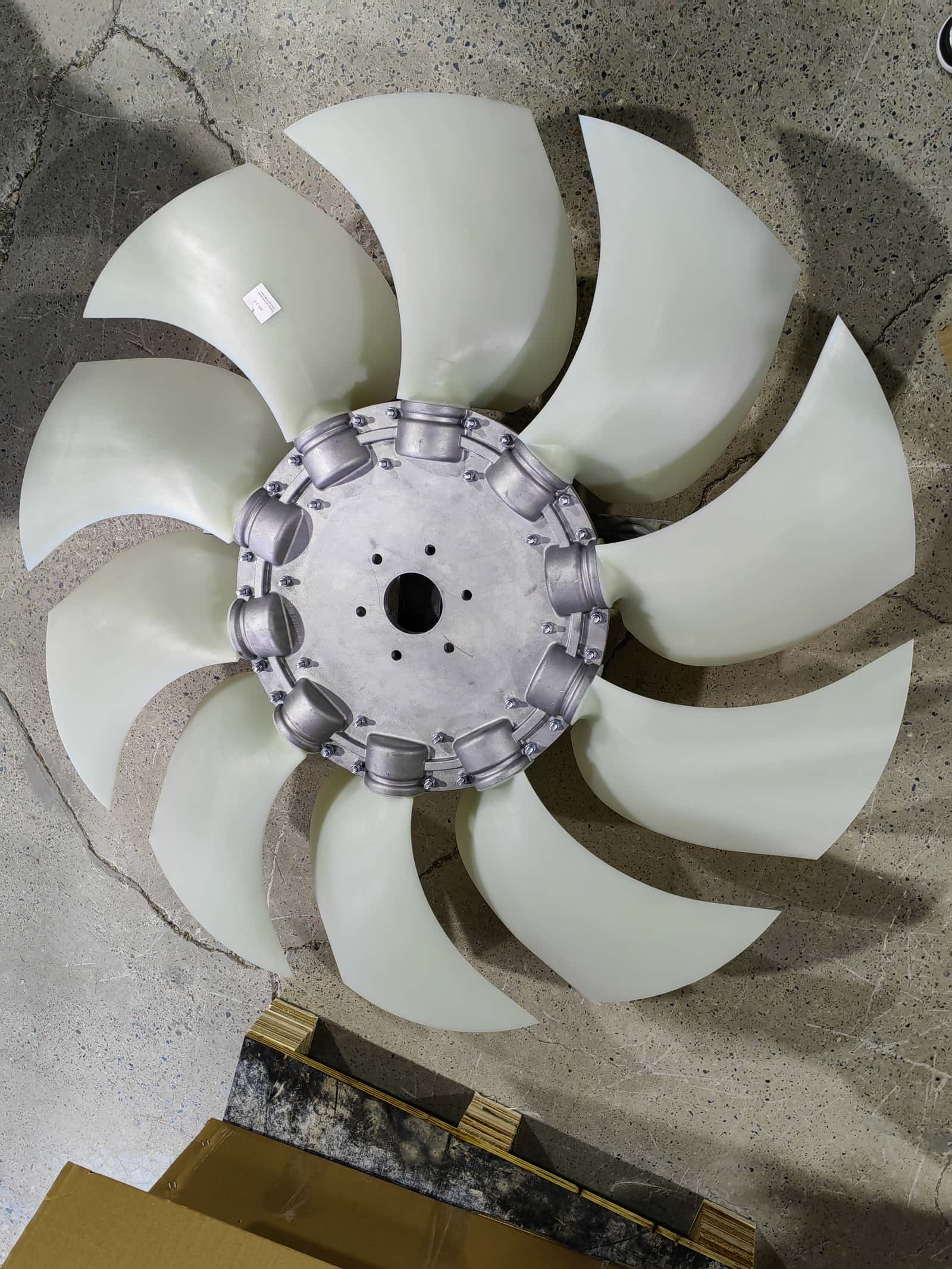
An axial fan blade is one aerodynamic component. An axial fan impeller is the rotating assembly that combines blades with the relevant hub and mounting arrangement. A complete fan can include additional equipment such as a motor, supports, guards or a casing. These terms should not be used as interchangeable purchase descriptions. For this 5W replacement route, specify the complete impeller and identify any additional items separately. A quote for an impeller should not be read as a quote for a motorized fan unless the scope explicitly includes the drive and other equipment. The industrial axial fan impeller range provides the broader product context, while this guide concentrates on the corresponding 5W replacement order.
What does adjustable pitch mean for an order?
Adjustable pitch means the assembly has a defined blade-angle setting that can be selected for the configuration. It does not mean an operator should change the setting arbitrarily while trying to recover cooling performance. Record the required setting and its measurement convention with the approved assembly information. If the existing angle is unknown, provide the operating requirement and available documentation for review. Do not transfer an angle from an unrelated blade profile simply because the diameter looks similar. A complete order identifies which blade family, hub arrangement and setting belong together. It also records how the setting will be reproduced for a later repeat order.
What does the W-3 hub family tell a buyer?
The UTEK-DELE 5W material index identifies the W-3 hub family for the listed range. That is useful family information, but it does not provide every shaft, bore, keyway, bushing or mounting dimension of a particular delivery. The purchase record must still connect the chosen hub configuration to the machine interface. Use the approved drawing and the actual connection details rather than assuming that the family name settles the entire fit question. A shared family name should not be interpreted as permission to mix arbitrary existing and replacement components. In the corresponding replacement route, the supplied assembly and its interface are specified together.
Why should mechanical fit and operating duty be recorded separately?
Mechanical fit asks whether the assembly connects and clears the surrounding equipment as intended. Operating duty asks what airflow and pressure requirement it must meet at the specified conditions. A record that answers only one question is incomplete. The motor, rotational speed, air path and installation conditions matter even when the impeller is a direct model replacement. Separate these records so a drawing revision cannot silently change the performance request, or an altered duty cannot be mistaken for an unchanged spare order. This separation also makes quotations easier to compare because suppliers can state the same scope against the same requirements.
From a Replacement Request to an Order-Ready 5W Assembly
European buyers reviewing replacement costs need a concrete alternative and a reliable way to specify it. UTEK-DELE's corresponding 5W complete impeller provides that direct replacement route. Rather than making a general statement about every European price or promising an unsupported percentage saving, compare quotations for the same configuration and supply boundary. The useful comparison identifies what is included, which interface is supplied, which operating requirement applies and what documentation accompanies the assembly. A lower headline price for loose blades is not directly comparable with a complete impeller quotation. Neither is a quote that omits an essential mounting component or leaves the material unresolved.
The axial fan blade cross-reference guide helps buyers identify the relevant model relationship. This article takes the next step for 5W: it organizes the order around the installed assembly, the machine interface and the replacement scope. It does not repeat the whole cross-reference table or list unrelated models to make the article appear broader. The purpose is to help a maintenance buyer, OEM engineer or procurement team prepare a request that can be answered precisely. Once those fields are established, later orders can refer to the approved configuration rather than recreating the discussion from a short model name and a photograph.
Start by deciding whether the request is an unchanged spare, a fleet replacement or a revised operating requirement. An unchanged spare aims to reproduce the approved build for a known installation. A fleet replacement needs a clear list of which machines share that build and which differ. A revised requirement, such as a different speed or air path, should be identified as a change instead of hidden inside a spare-parts order. This distinction protects the buyer from comparing unlike proposals. It also prevents an otherwise straightforward direct replacement from being asked to solve an unrecorded equipment modification without anyone acknowledging that the requirement has changed.
Define the Complete-Impeller Supply Boundary
Write what is included before comparing prices
List the rotating assembly and the agreed mounting components explicitly. State whether the order includes blades, hub, relevant bushings or connection elements, and any separately specified hardware. Do not assume that a photograph of a complete fan defines the commercial delivery. The picture may show a guard, motor or support structure that is outside the impeller order. A scope table should distinguish supplied items from existing equipment retained on the machine. Where an item is to be reused, identify the record that confirms its suitability and connection. This makes responsibility visible without implying that every existing component can automatically remain in service.
The corresponding 5W replacement is supplied as a complete impeller, consistent with the whole-assembly scope recorded in the user-provided model comparison. That route avoids presenting unverified blade-to-hub mixing as the default repair. If a buyer asks for loose components, handle that as a separate technical and commercial request. Do not infer permission from the complete-impeller relationship. The same discipline applies to an existing bushing or fastener set: reuse is a configuration decision, not a consequence of matching a brand or family name. Keeping the boundary explicit makes the direct replacement proposition clearer, because the customer can see precisely which assembly is offered instead of having to guess what replacement means.
Keep the original identification and replacement identity side by side
Create two fields rather than overwriting the original model with the replacement model. One preserves the original equipment identification as observed; the other identifies the agreed UTEK-DELE assembly and drawing revision. Keep the machine or asset number alongside both. This arrangement supports maintenance traceability and prevents a later buyer from mistaking an internal replacement code for an original manufacturer's code. Where several original configurations are covered by a procurement program, list them individually or through a controlled equivalence record. Do not let a broad spreadsheet heading silently expand an approved mapping to every possible variation in the original model family.
Distinguish a replacement program from a single loose spare
A replacement program usually needs a repeatable record rather than a one-off verbal description. Record the approved assembly, the machines to which it applies, the required documentation and the change-control contact. If the customer orders again after modifying the drive or casing, the old order number should prompt a review of those changes rather than an automatic assumption that the original configuration still applies. This does not require elaborate paperwork. A clear drawing reference, interface table and revision history can prevent repeated ambiguity. The goal is to make the next purchase simpler while keeping the technical basis visible.
UTEK-DELE 5W: Documented Range and Ordering Limits
The following values are the UTEK-DELE 5W family information recorded in the site's documented product information and consistent with its published product description. They describe the available family and must not be confused with the full extent of another manufacturer's range. The official Multi-Wing modular brochure identifies 5W within its own modular product system; its dimensions and options belong to that system. This guide does not transfer those values to UTEK-DELE. For an actual replacement order, use the identified corresponding configuration and approved drawing. A family-level range narrows the discussion; it is not a substitute for specifying the assembly required by your installation.
| Field | UTEK-DELE 5W family information | Ordering interpretation |
|---|---|---|
| Replacement scope | Complete impeller for corresponding mapped Multi-Wing 5W configurations | Does not authorize arbitrary mixed loose components |
| Pitch | Adjustable; set for defined build | Record setting and reference convention |
| Diameter | 560–2200 mm | Family range; confirm ordered dimension |
| Blade count | 6–12 | Confirm actual assembly arrangement |
| Hub | W-3 family | Confirm complete machine interface |
| Materials | PAG / conductive PAGAS / ALU in indexed family | Confirm material and any separately required evidence |


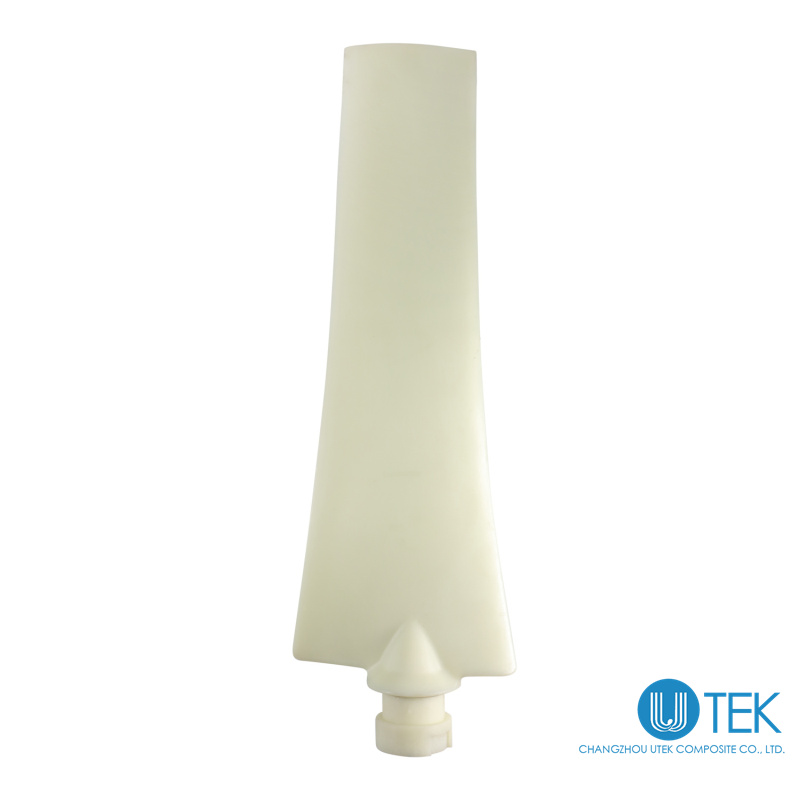
The UTEK-DELE 5W product page is the appropriate product destination for this assembly discussion. Read its available drawings in connection with the order, not as proof that one catalogue image represents every blade count or connection. Some illustrations show the blade form or a representative assembly. State whether a photograph is being used to identify a visible feature or to define a controlled dimension. A visual comparison is useful for orientation, but dimensional acceptance should refer to the approved drawing and measurement basis. This is particularly important when equipment has been repaired previously and the current configuration may differ from an early catalogue illustration.
Material options also need version-level confirmation. PAG, conductive PAGAS and aluminium are identified in the 5W family information. PAGAFR is a separate PA6, glass-fiber and flame-retardant-additive option recorded by the company; its availability and suitability for the requested build should be confirmed rather than silently substituted for PAG. A conductive material designation is not by itself an ATEX certification. A material screening temperature is not automatically the rating of the complete fan, motor, hub and installation. Keep required material behavior and required certification evidence as separate order fields. This prevents a convenient acronym from carrying claims that the underlying record does not support.
Establish Mechanical Fit with a Defined Reference
Diameter and radial clearance
Record the actual required outside diameter and identify the surrounding ring or casing. A nominal family size is not the same as a measured assembly diameter. Note the source of the value: equipment drawing, approved original specification or a controlled measurement of the installed arrangement. If damage prevents a reliable measurement, explain the condition rather than estimating a precise dimension from a photograph. The installation's required radial clearance belongs to the relevant equipment and assembly documentation. This guide does not invent a universal millimeter gap. A replacement order should name the requirement or request its clarification so the delivered assembly can be checked against a defined installation condition.
Radial fit should be considered around the full installation, not only at one convenient point. Distortion, previous modifications or an incorrect reference can make a single measurement misleading. Record any known casing condition that affects the review. The buyer does not need to diagnose every possible machine fault before requesting a quote, but should distinguish an original design dimension from a measurement taken on damaged equipment. That distinction helps the reviewer understand what each value can establish. It also prevents a replacement impeller from being specified to reproduce accidental deformation rather than the intended machine geometry.
Shaft connection and mounting details
Identify the shaft connection using the information required by the approved interface drawing. Relevant fields can include bore, bushing type, keyway, bolt pattern and connection orientation, but the applicable set depends on the machine. State units and references clearly. A picture with a ruler may be useful for preliminary identification, yet it should not be represented as a controlled machining dimension unless the method supports that purpose. If a bushing carries a readable marking, preserve it with the other records. Do not assume that two items with similar external appearance have the same internal interface or retention arrangement.
For a retained machine component, record its condition and the authority for reuse where that is part of the repair process. The replacement supplier can define the new assembly, but the buyer must also identify the existing equipment to which it will connect. An order that merely says match our shaft can leave essential details unresolved. Provide the drawing or the agreed measurement set and identify who will approve the result. This reduces the chance of a commercial order being released before the mechanical question is actually closed. It also gives both sides a clear reference if the machine has changed between quotation and installation.
Axial envelope and installation orientation
Outside diameter does not describe the axial space occupied by the hub and blades. Record the relevant mounting face, offset and available envelope, including nearby guards, supports or other equipment where they affect the assembly. Photographs should show the mounting relationship, not only the front view of the blades. Label the viewing direction so rotation and axial orientation are not confused between people looking from opposite sides. A short annotated sketch can be more useful than several unlabeled close-ups. The point is not to create an elaborate drawing package for every inquiry, but to establish the references that make the existing information interpretable.
Rotation should be stated with its observation direction. Clockwise from one side becomes counterclockwise from the other, so a bare abbreviation can create ambiguity. If the original identification encodes rotation, preserve the complete code and its interpretation reference. If a photograph includes a rotation arrow, show where that arrow belongs on the equipment. Do not infer rotation solely from a blade's apparent curve in a photograph. A clear record can contain both the stated direction and the view used to describe it. This simple addition helps prevent a correct family selection from becoming an incorrect installation request.
Connect the Assembly to the Operating Requirement
Preserve speed, airflow and pressure as separate fields
Record the actual operating speed and the required airflow and pressure with their units and measurement conditions where available. Do not substitute motor frequency for verified impeller speed without identifying the drive arrangement. Do not use an airflow figure without explaining the pressure or installation condition to which it belongs. The purpose is to preserve the existing approved requirement, not to calculate an unsupported new duty from a family name. If only partial information is available, provide it honestly and identify the missing fields. An incomplete but clearly described requirement is a better starting point than a complete-looking table filled with assumptions.
The W Series product family includes several related models, but a shared family does not make their published descriptions a common performance curve. The related 6W assembly and 1W assembly are separate product references that help buyers understand the range; they are not substituted for 5W within this guide. If the operating requirement changes enough to prompt a different model review, identify that as a separate selection decision. Avoid changing the model behind a direct replacement quotation without making the change visible. A clear distinction between equivalent replacement and redesigned selection protects both technical review and commercial comparison.
Record the surrounding air path
A cooling or ventilation system includes more than its rotating impeller. The air path can contain heat exchangers, louvers, guards, duct transitions or obstructions. Record known changes to these elements when requesting a repeat assembly. A replacement order intended for an unchanged installation should say so, while an altered air path should be identified as a revised condition. This is not a request to invent detailed system resistance data when none exists. It is a way to prevent a known equipment change from remaining hidden behind the phrase same as before. Where a test or equipment record exists, cite it rather than reconstructing a requirement from memory.
Plan access for the assembled fan
This site video shows a cooling-tower fan assembly being lifted into position. Use the scene to recognize why access, the surrounding structure and the complete assembly envelope belong in installation planning; the specific model shown is not established as 5W.
The clip is a field illustration, not a complete lifting or installation instruction and not evidence of a 5W performance test. Follow the approved equipment and site procedure for the actual assembly.
Keep performance comparison at like-for-like conditions
If performance verification is part of the order, agree what will be compared and under which conditions. Diameter, speed, configuration, measurement setup and operating point must be sufficiently defined for the comparison to mean anything. A maximum free-air value from one source and a duty-point value from another do not form a like-for-like comparison. Nor does a material description establish noise or power consumption for the installed machine. This guide therefore does not promise an unverified energy-saving percentage, universal noise reduction or unchanged performance for every possible configuration. The direct replacement offering is specific; additional numerical performance claims need their own stated evidence.
Complete Impeller Versus Loose-Blade Procurement
| Question | Complete-impeller route offered here | Loose-component request |
|---|---|---|
| Mapping | Confirmed corresponding 5W replacement relationship | Not automatically approved by assembly mapping |
| Supply | Defined blade and hub assembly | Requires separate compatibility confirmation |
| Interface | New assembly matched to machine connection | Existing internal connection cannot be assumed |
| Documentation | Assembly drawing, scope and revision | Additional component interface basis needed |
| Purchasing | Compare equivalent complete scopes | Do not compare loose blade price with full assembly price |
The distinction matters because a complete-assembly relationship can be misunderstood as permission to reuse every interface inside the original impeller. For the corresponding Multi-Wing 5W replacement, the offered UTEK-DELE 5W complete impeller is the clear procurement route. It defines the rotating assembly as a unit. If the buyer instead wants to retain an original hub and replace individual blades, that request needs a separate confirmed compatibility basis. It should not be approved merely by deleting the hub from a complete-impeller quotation. Keeping the two routes separate makes the original offer easier to understand and reduces the chance of an unauthorized mixed assembly reaching the installation stage.
Scenario: replacing one documented assembly
When a single machine has a complete equipment record, begin with that record and identify any changes since the last approved build. Preserve the original identification, required diameter, blade count, rotation and connection. Add photographs that show the actual condition and mounting relationship. The replacement request can then cite the corresponding UTEK-DELE assembly with a defined scope. This is an illustrative purchasing scenario rather than a claimed customer case. No operating improvement or test result is implied. Its value is the sequence: establish the installed configuration, confirm the complete replacement, and compare a quote that actually covers the required assembly.
Scenario: standardizing spares across several machines
For a fleet, do not assume that similar-looking fans all use one configuration. Create an asset list and record the fields that can differ: diameter, blade count, pitch setting, rotation, connection and duty. Group only the configurations shown to be the same. An approved replacement drawing can simplify repeat orders, but it should be linked to the correct asset group. If one machine has a different drive or casing revision, keep it outside the common group until the difference is resolved. This approach can reduce future purchasing confusion without pretending that a family name eliminates all installation differences.
Build a Comparable Replacement Quotation
Use a configuration sheet, not a price-only request
A useful inquiry begins with the original model and the proposed corresponding replacement, then states the complete-impeller supply boundary. Include the known mechanical interface, operating requirement, material requirement and quantity. Name the documents available and identify any unresolved fields. This allows a quote to show what has been confirmed and what remains conditional. It also makes price comparison more honest: two proposals can only be compared properly when their supplied scope and technical requirements are aligned. The direct axial fan replacement model guide provides a visual overview of the supported replacement relationships, rather than an implied online quotation form.
| Record group | Required description | Why it matters |
|---|---|---|
| Original identity | Full original model/configuration; asset number | Connects request to actual installation |
| Replacement | UTEK-DELE 5W complete impeller; drawing revision | Defines offered rotating assembly |
| Geometry | Diameter; mounting face; axial envelope; connection | Separates fit from visual similarity |
| Configuration | Blade count; rotation/view; pitch; material | Prevents family-name ambiguity |
| Duty | Speed; airflow; pressure; conditions where available | Preserves actual operating requirement |
| Commercial scope | Quantity; currency; delivery term; inclusions/exclusions | Enables like-for-like quotation |
| Approval | Reviewer; drawing revision; change record | Makes repeat orders traceable |
Separate the unit price from freight, packaging, taxes and other commercial terms where they apply. Record the currency, quantity basis and delivery term. Do not compare a single sample price with a production quantity price without acknowledging the difference. If a proposal includes a trial, inspection document or special interface work, identify those items rather than treating them as hidden extras. This article does not claim a fixed landed-cost saving or a particular delivery promise. It gives buyers a way to compare the direct replacement on a consistent basis. Where the actual quotes demonstrate a difference, the customer can evaluate that difference against the same configuration and scope.
Make exclusions visible
An exclusion is useful when it prevents misunderstanding. If the quote does not include a motor, guard or site installation, state that plainly. If a retained machine component must be confirmed by the buyer, identify it. Do not conceal an unresolved interface behind a general note saying subject to technical confirmation when the exact missing field can be named. A focused condition is easier to close than a vague disclaimer. Conversely, do not add broad uncertainty language that undermines an established model replacement relationship. State the supported replacement clearly, then list the order-specific information needed to configure and supply that replacement correctly.
Preserve the approved version after purchase
Once the configuration is approved, record the drawing revision, order reference and relevant supplied identifiers together. If the buyer changes a connection or material after approval, make the revision visible rather than allowing the latest email to become an undocumented exception. Repeat orders should refer to the approved build and declare whether the machine conditions remain unchanged. This protects the value of the initial technical review. Without version control, a later order can reuse a familiar part name while silently requesting a different assembly. A compact revision record is often enough to keep the relationship between original equipment and replacement supply clear.
Common Mistakes in a 5W Replacement Request
Mistake 1: comparing family names instead of configurations
The remedy is to keep the full original identification and the approved replacement build in the same record. A family name is a useful search term, but it is not the complete order. Diameter, blade count, pitch, material, rotation and connection should not be left to guesswork. This is especially important when an installed assembly has already been repaired or altered. Use the equipment record and actual condition together, and identify any disagreement before the order is released. Do not let a shorthand name replace a drawing or an approved configuration where those documents are available.
Mistake 2: treating complete replacement as loose-blade compatibility
The remedy is to retain the complete-impeller supply scope for this mapped replacement route. A buyer who specifically needs individual components should raise that as a separate request and obtain a corresponding compatibility decision. It is not enough to show that the blade outline looks similar or that both assemblies belong to a broadly comparable family. The original and new internal connections, retention and configuration must not be assumed interchangeable. Clear scope prevents an otherwise supported direct replacement from being interpreted as an instruction to create an unverified mixed assembly.
Mistake 3: using only a front photograph
The remedy is to include views that explain the mounting face, hub connection and axial relationship, with units and viewing direction stated. A front photograph can identify blade form and approximate arrangement, but it may hide the connection that determines whether the assembly fits the drive. Add a readable label or drawing where available. Do not digitally distort photographs to make two assemblies appear identical. Useful visual evidence preserves what can actually be seen and links it to the correct model. Dimensional acceptance should remain tied to a defined drawing or approved measurement record.
Mistake 4: transferring an angle from another fan
The remedy is to identify the actual blade family and the approved angle convention. A number without its reference or configuration can be misleading. Do not copy a setting from another model because its diameter or application name is similar. Where the original setting is unknown, provide the known duty and equipment information for review. The order record should explain the resulting configuration so a repeat assembly can be requested consistently. This guide does not provide a universal best angle, because such a value would conceal the dependence on geometry and operating conditions.
Mistake 5: interpreting material names as system certification
The remedy is to state material requirements and certification requirements separately. Conductive PAGAS is a material designation, not automatic evidence that the complete installation is certified for a classified atmosphere. PAGAFR adds flame-retardant ingredients to a PA6/glass-fiber formulation, but a requested fire classification still needs the relevant evidence for the intended product and use. Do not infer a whole-fan rating from a material screening range or a patent description. The order should identify which document is required and which assembly it must cover, rather than relying on an acronym to carry the entire compliance claim.
Mistake 6: assuming balancing removes all installation checks
The remedy is to keep factory assembly and balancing evidence separate from the equipment's installation and commissioning requirements. The documented company information supports balancing capability; it does not establish a universal exemption from every site check. Do not promise that a replacement can be installed without following the relevant equipment procedure. Transport condition, mounting and retained machine components remain part of the installation context. Ask for the documentation required by the order and use the approved machine instructions. This avoids turning a useful manufacturing quality process into an unsupported claim about all future service conditions.
An Order-Preparation Sequence for the Replacement
- Record the original Multi-Wing 5W identification and the machine or asset reference. Preserve the full available code and distinguish direct observations from incomplete or reconstructed information.
- State the corresponding UTEK-DELE 5W complete-impeller replacement route. List supplied items and retained equipment so loose-component assumptions cannot enter the order unnoticed.
- Define diameter, blade count, rotation with viewing direction, pitch information and material requirement. Use the approved original record or identified measurements rather than visually estimated precision.
- Provide the shaft connection, mounting references and axial envelope through the relevant drawing or agreed measurement set. Name any unresolved interface field explicitly.
- Record operating speed, airflow and pressure requirements with units and conditions where available. Identify known changes to the drive, casing or air path as changes rather than unchanged spare requirements.
- Compare quotations using the same configuration, quantity, supplied scope and commercial terms. Keep extra services, documents, freight and exclusions visible instead of comparing headline prices alone.
- Approve the assembly drawing and order revision through the responsible process. Preserve the record that connects the original configuration to the supplied replacement and any agreed restrictions.
- Keep the approved build reference for repeat orders, while checking whether the installation remains unchanged. Use the equipment's applicable installation and commissioning procedure rather than an improvised universal setting.
The sequence is deliberately centered on information that changes a purchasing decision. It should not become a barrier that requires buyers to invent data they do not have. If the original drawing is unavailable, identify that fact and agree the next evidence needed. If the machine is still operating and cannot be measured safely, do not improvise a measurement procedure from an article. Plan the information collection with the responsible personnel. A clear record of known and unknown fields helps the review move forward without making the direct replacement message vague or turning a preliminary request into an unsupported technical guarantee.
Quality Assurance and a Reusable Configuration Record
For quality review, connect each requested document to the actual supplied assembly. A material record should identify the relevant material or batch as required. An assembly drawing should identify the ordered configuration and revision. A balancing or inspection record, where included in the order, should be traceable to its defined scope. Do not use a generic certificate image as proof of every product property. The objective is a coherent evidence pack that supports the customer's requirement. Keep the information practical: buyers should be able to tell which assembly was ordered, what was checked, and which installation requirements remain governed by the machine documentation.
For repeat procurement, a reusable configuration sheet should preserve both the technical and commercial baseline without becoming a substitute for change control. Keep the original model reference, UTEK-DELE build, drawing revision, interface, material and duty together. Record the order history separately so a quantity or delivery change does not overwrite the approved engineering information. If a later order proposes a different material or revised connection, treat it as a visible revision. This makes the direct replacement program more useful over time: the buyer can return to a defined assembly instead of restarting identification from an old photograph and an ambiguous part description.
Frequently Asked Questions
Can UTEK-DELE directly replace the corresponding Multi-Wing 5W impeller?
Yes. UTEK-DELE supplies its corresponding 5W complete impeller as the direct replacement route in the confirmed model mapping. Specify the installed configuration and machine interface so the supplied assembly matches the actual order.
Does this mean a loose replacement blade fits every original 5W hub?
No. The stated replacement route is the complete impeller. A loose-component or mixed-hub request requires a separate confirmed compatibility basis and should not be inferred from the complete-assembly mapping.
What UTEK-DELE 5W family dimensions are documented?
The product information records a 560–2200 mm family range, 6–12 blades and the W-3 hub family. These are UTEK-DELE family values; they do not expand the approved scope of a specific order or reproduce another manufacturer's full range.
Should the order include a motor and casing?
Only if the agreed supply scope explicitly includes them. An impeller is the rotating assembly, while a complete fan can include a drive, casing, guards and supports that must be identified separately.
Can a pitch setting from another blade family be reused?
Do not assume so. The setting must be associated with the selected geometry, reference convention and operating requirement; an unrelated angle value does not define a valid replacement build.
Is PAGAS automatically an ATEX-certified fan?
No. Conductivity is a material characteristic and does not independently certify the complete assembly or installation. Specify the required approval evidence separately for the intended configuration and use.
What photographs are most useful for a replacement inquiry?
Provide readable identification and views of the whole assembly, hub connection and mounting relationship, with viewing direction clear. Use approved drawings or an agreed measurement method for dimensional acceptance rather than estimating dimensions from photographs.
Is a price saving guaranteed for every replacement order?
No universal saving is stated. Compare actual quotations for the same assembly configuration, supplied scope, quantity and delivery terms to evaluate the commercial alternative fairly.
Final Thoughts
The corresponding UTEK-DELE 5W complete impeller is a clear direct replacement offering for the mapped Multi-Wing 5W configurations. The purchasing task is to define that assembly accurately, rather than to repeat the family name and leave the details implicit. Keep original identification, replacement build, interface, duty and commercial scope connected in one controlled record. Use real product photographs for identification, approved drawings for dimensional decisions, and like-for-like requirements for price and performance comparisons. This makes the replacement proposition understandable to both technical and purchasing teams while keeping unsupported claims, mixed-component assumptions and unnecessary uncertainty out of the order.